Living off-grid in Spain is legal and common in the dry interior. The power side is the easy part. What decides whether it works is the land: whether the house on it is legal, whether you are allowed to build or extend, and where the water will come from in August. Those rules are set by each region, not by Madrid, so the same plot-sized dream can be simple in one region and impossible in the next.
This page is the overview. It explains how rural land works, what power, water, waste and internet involve, and how the seven regions covered on this site compare, with a link to the full guide for each. If you have already found a plot, the nine things to check before going off-grid is the shorter, practical list.
What “off-grid” means for a Spanish property
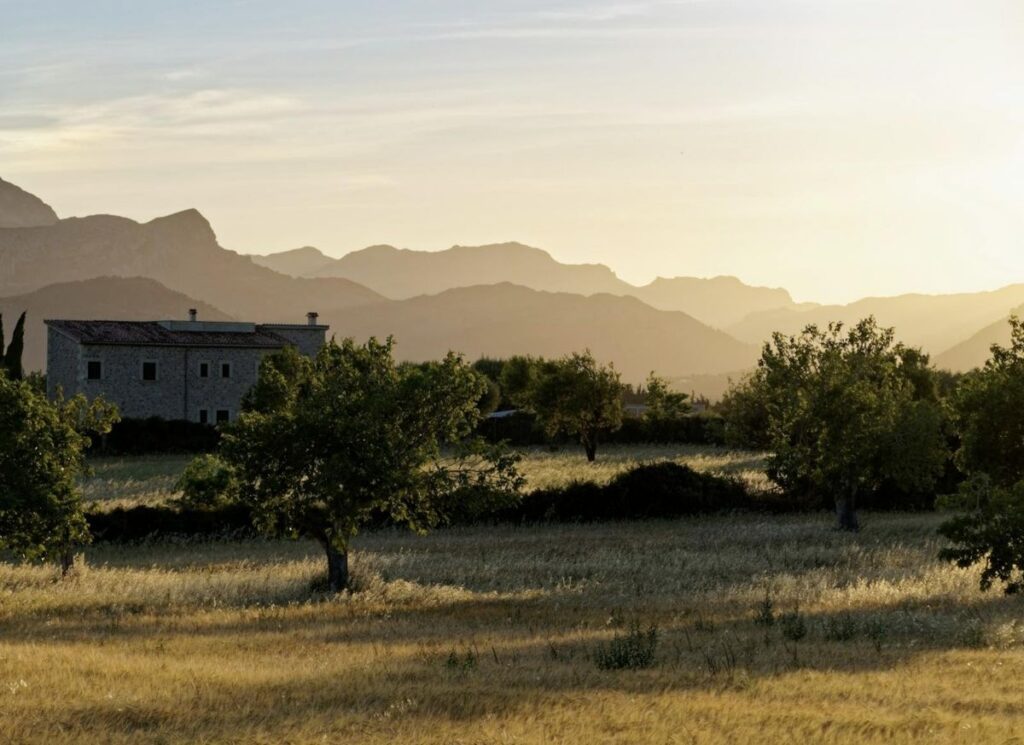
A typical off-grid home in Spain is not on a mountain top. It is a country house on suelo rústico, rustic land, a few kilometres outside a village, where running in a mains connection would cost more than producing your own power. Many such houses were built decades ago, some with every licence and some with none, and a lot of the paperwork you will meet comes from that history.
Rustic land is protected from building by default. Each region’s planning law says what can go on it, and each town’s plan then fixes the category of every plot. So the first question about any finca is never the view or the price. It is whether the house, and every extension, pool and casita around it, is legal, and what the rules let you do next.
The law, in plain English
Three things come up again and again, in every region.
The first is the minimum plot for a new house. Buying a cheap field and building on it is rarely possible. In Andalucía a detached house on ordinary rustic land needs at least 2.5 hectares, in Murcia a house has to be tied to a working farm of at least 20,000 m², and in Extremadura each town sets its own figure. A one-hectare plot with a ruin on it is often too small to build anything new.
The second is what happens to old unlicensed buildings. In Andalucía, once six years have passed, the council can usually no longer order demolition and the house can be declared AFO: tolerated, though not fully legal. In the Valencian Community the opposite applies on rustic land, where there is no time limit at all. The details, and what AFO and DAFO status let you do afterwards, are in the guide to legalising a rustic house.
The third is what the paperwork says against what is standing. A house can be in the Catastro, have a meter on the wall and still lack a licence. The checks before buying rural land go through the documents in order, the cadastral reference guide shows how to look a plot up, and building regulations for rural properties covers what you can add. Thinking of a ruin or a container house instead? Read buying a ruin, step by step and container houses on rustic land first.
None of this replaces an independent lawyer and an architect who know the town. It tells you which questions to ask them before you agree a price.
Power: sized for December
An off-grid solar system is sized for the shortest days, not the brochure average. How much a kilowatt of panels produces in winter varies a lot across Spain, from about 3 kWh a day in Murcia and on the Almería coast to under 2 kWh in inland Galicia. For a household using 10 kWh a day, that is the difference between about eight 550 W panels and twelve or thirteen.
The rest of the system is a battery bank to carry you through the night and a cloudy spell, an inverter big enough for the largest load you will run at once, and usually a generator for the worst weeks. A kit with 9.6 kWh of lithium storage and a 5 kW inverter costs €3,600 to €3,700 for the equipment alone, before installation and legalisation. The solar sizing guide works through the numbers, with batteries, generators and wind turbines covered separately, and the power hub puts it in order.
Heating and cooling are what break small systems. Inland Spain is cold in January and very hot in August, and both extremes push a house towards electric loads that solar struggles to carry. A wood stove, good insulation and shade do more than extra panels; see heating an off-grid home, passive solar design and the heating and cooling hub.
Water: the hard part
Power you can buy in a week. Water you cannot. There are four sources, and most off-grid houses use two or three of them.
Rainwater is free once a tank is in, but a 100 m² roof gives roughly 20,000 litres a year in a dry region, about 55 litres a day, which is a top-up rather than a supply (see rainwater harvesting). A borehole is the most reliable source inland if the ground has water, but it costs €1,800 to €15,000 with no promise of water at the bottom, and it needs permission from the river basin authority (see borehole permits). Tanker deliveries are the fallback almost everyone uses at some point, at around €190 for 10,000 litres (see water deliveries and storage tanks). Old wells and shares in a local irrigation community can be worth more than a bigger plot, but only if they are registered and still give water in late summer.
Whatever the source, drinking water usually needs treating; water filtration explains the usual three stages, and the water hub brings it together.
Waste
An off-grid house needs its own wastewater system, and in several regions it is the thing that decides whether an older house can be made legal. A septic tank costs €900 to €5,000 for the tank, plus fitting from €1,500 and licences of €500 to €2,000. A small treatment plant costs €2,000 to €4,000 installed. The septic tank rules cover permits and discharge, and septic tanks vs compost toilets weighs up the alternative.
Internet and access
Mobile coverage in rural Spain is patchy, and a valley can be dead while the hill above it has 4G. Check the signal at the plot itself, not in the village, and plan on satellite where there is none; the internet guide and the map of areas with no 4G help. Drive the access track after rain as well. Who owns and maintains it matters as much as the house (see access tracks and driveways).
The seven regions compared
These are the regions with a full guide on this site. Purchase tax is the general rate on a resale house; reduced rates exist in every region for some young buyers and large families. Winter output is per kilowatt of panels, per day, before losses.
| Region | Purchase tax | The land rule that matters most | Winter solar per kW | Panels for 10 kWh a day | Water |
|---|---|---|---|---|---|
| Andalucía | 7% | 2.5 hectares for a new house; old ones can be declared AFO after six years | 2.9–3.3 kWh | 7–8 | Scarce in the south-east; Guadalquivir basin inland |
| Murcia | 7.75% | A house tied to a working farm of at least 20,000 m² | about 3.0 kWh | 8 | Famously short, in the Segura basin |
| Valencia and Alicante | 9% | No time limit on unlicensed building on rustic land; a regularisation route for houses finished before 20 August 2014 | 2.8–3.0 kWh | 8–9 | Júcar and Segura basins; boreholes need permission |
| Catalonia | 10%, more on dearer homes | Restoring a masia depends on the town’s catalogue of rural buildings | 2.2–2.5 kWh | 10–11 | Wetter in the north; drier in the south |
| Galicia | 8% | Hamlet boundaries decide what can be built; restoring traditional houses is encouraged | 1.8–2.0 kWh | 12–13 | Plentiful; rainwater harvesting works well |
| Extremadura | 8%, more on dearer homes | Minimum plots set town by town, often a hectare and a half or more | about 2.7 kWh | 9 | Tajo and Guadiana basins; big plots, long distances |
| Castilla-La Mancha | 9% | One house per plot; an urgent planning reform, Ley 7/2026, has applied since 18 November 2026 | 2.5–2.8 kWh | 9–10 | Groundwater under pressure; new boreholes tightly controlled |
Tax rates are from the Ministry of Finance’s summary of regional tax measures for 2026. Winter output figures come from Profile Solar location data, quoted in each region guide; panel counts assume a 20% allowance for losses. Each region guide links its own sources.
Which region suits you
If winter sun and a short, mild winter matter most, the south-east is hard to beat: Murcia, inland Almería in Andalucía, and inland Alicante in the Valencian Community. The price is water, which is short in all three.
If water and green land matter more than sun, look north to Galicia, accepting that the solar system has to be bigger and the houses fight damp rather than heat. Catalonia has the old stone masies and the highest purchase tax.
If space is the point, Extremadura and Castilla-La Mancha offer big plots at inland prices, with long drives to everything and hard winters on the plateau.
What it costs
Purchase tax is the largest single cost after the house itself: on a €150,000 resale house it runs from €10,500 in Andalucía to €15,000 in Catalonia. Setting up power, water and waste comes on top: on the prices in the region guides, from under €10,000 for a solar kit, a rainwater tank and a septic tank, to around €35,000 with a deep borehole and the dearest options, before the cost of installing the solar system. Whether you need a borehole makes most of the difference. The cost of going off-grid has three sample budgets, and the first-year running costs cover what comes after.
The supplier directory lists solar installers, borehole drillers, septic tank firms and property lawyers by province.
Leave a Reply