
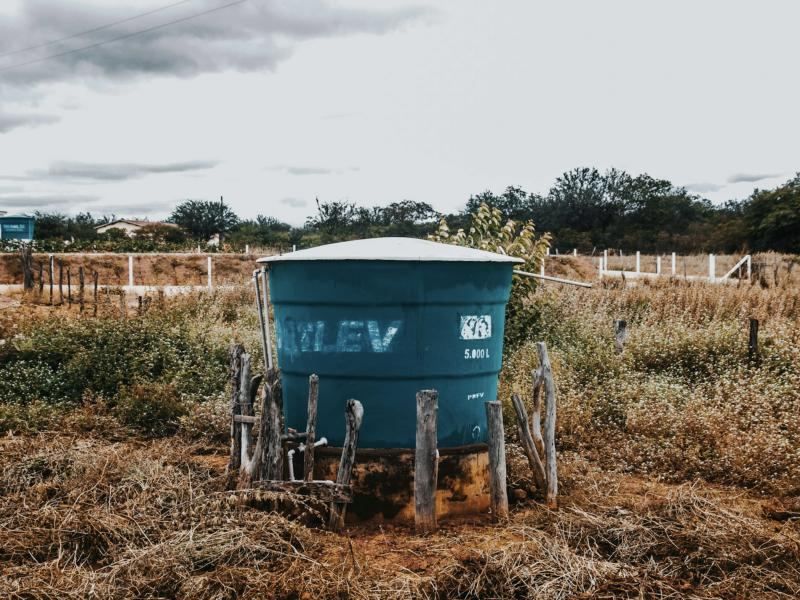
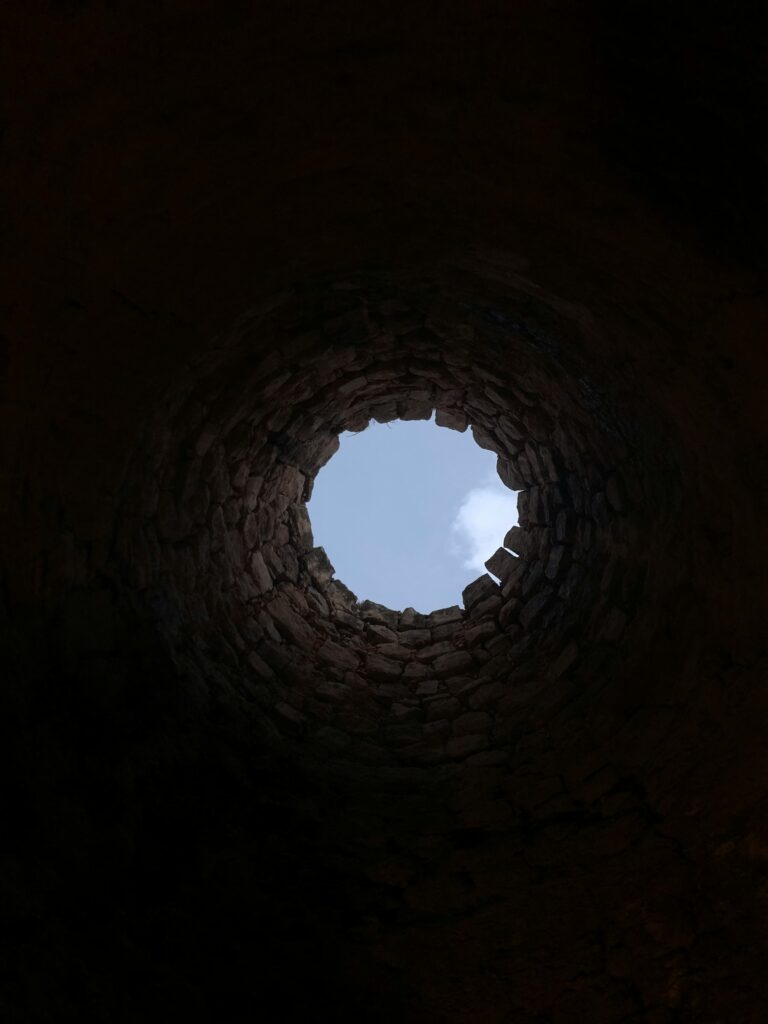
When we bought the finca, it came with a well. A lovely old stone thing with a rusty pulley, the kind of feature agents photograph at sunset. It was also completely dry. Not low. Dry.
So our first months ran on rainwater, greywater and deliveries (I’ve written about tanks and deliveries separately), and in the summer of 2025 we drilled a borehole. It now feeds the house through a 1.1 kW pump, which I’ve since tamed with a soft starter so the batteries don’t flinch every time someone flushes.
The drilling took days. The paperwork took longer. This guide explains who you need permission from, what the famous 7,000 m³ rule really means, what it costs, and what to do if the finca you’re buying already has a well.
I’m describing how the system works, not giving legal advice. The details differ between river basins and regions, so check with your own basin authority before you drill.
Groundwater belongs to everyone
The starting point surprises many British buyers: underground water in Spain is public. You don’t own the water under your land; you get a right to use it. That’s why a borehole involves the state, not just you and a drilling rig.
That right can’t be gained by squatting on it, either. Spain’s Water Act says the right to private use of public water cannot be acquired by prescription. A well that’s been pumping illegally for thirty years is still illegal.
Three authorities, three permissions
The Júcar river basin authority (CHJ), which covers most of the Valencian Community, publishes a plain-language note on drilling. It lists three separate authorities:
- The town hall grants the planning licence for the works. Expect to need a basic project signed by a competent technician and a basic health and safety study.
- The regional mining authority approves and controls the drilling itself. Under Spain’s mining safety rules, a borehole needs an approved project and must be carried out under a technical director.
- The river basin authority decides whether you can use the water. Its permission is also needed for works within 100 metres of either side of a watercourse, or on an aquifer that’s in poor condition.
In practice, a decent drilling company handles much of this, or works with an engineer who does. But the permissions are yours, so make sure your quote says who’s doing what.
The 7,000 m³ rule
Article 54.2 of the Water Act gives landowners a right to use groundwater on their own plot when the annual volume doesn’t exceed 7,000 m³. Above that, you need a full concession, which is a much longer process.
To put 7,000 m³ in perspective, that’s 7 million litres a year, or around 19,000 litres a day. A family house uses a small fraction of that. The 7,000 m³ rule exists for houses, gardens and smallholdings, which is exactly us.
Three conditions come with it:
- You still have to tell the authority before you use the water. The rule removes the need for a concession, not the need to apply. Spain’s Supreme Court has confirmed that the right can’t be exercised without the water authority’s involvement, which checks the volume and the plot before registering it.
- Above 3,000 m³ a year, you have to justify it. The regulation says that if annual use goes over 3,000 m³, you must show the volume fits the use you’re making of the water, without waste.
- The water stays on your plot. It can’t be used on a different property from the one where it’s drawn. No selling water to the neighbour, and no piping it to your other plot down the road.
How the application works (the Júcar version)
The CHJ’s information sheet on wells under 7,000 m³ a year is the best practical guide I’ve found. Other basins (the Segura, the Guadalquivir) work on the same law with their own forms and plans.
What you send
- The application form, signed by every owner of the plot.
- ID for each owner, and authorisation if someone applies on your behalf.
- An up-to-date nota simple from the Land Registry.
- A cadastral plan marking the drilling point and any wells, springs and water uses nearby, with distances, plus streams, tracks, mines and installations within at least 1,000 metres.
- A technical report giving the depth and diameter of the borehole, the pump’s power, how deep it sits, its maximum flow, the intended use and the calculation of annual volume.
If the water is for a garden or pool, you also need a certificate from the town hall that there’s no municipal drinking water supply.
The distance rules
This is where many plots fail. The CHJ requires a minimum of 100 metres between a new well and existing wells or springs. For very small flows (under 0.15 litres a second), that drops to 10 metres on urban land and 20 metres on non-developable land. Wells in the protection zone of a public watercourse need the basin authority’s permission.
There are flat refusals too. The CHJ won’t allow wells for supply on urban land, and won’t allow a new well on a plot that already has water rights, to avoid counting the same water twice.
What happens next
The CHJ checks the paperwork, the maps and the hydrological plan, and may visit. If it’s happy, it notifies you that you can drill and use the water, and enters the well in Section B of the Water Register. If not, you get a request for more information (with 10 days to answer) or a hearing to make your case.
If the final answer is no, the well counts as illegal and has to be sealed, with the materials removed.
After drilling
You’re not done when the water comes up. The CHJ requires:
- A certificate of completion with the UTM coordinates, depth, diameters and casing.
- A volumetric meter at the pump outlet, with a certificate of conformity.
- A note to the CHJ of the meter’s make, model, serial number and reading.
The meter matters. It’s how you prove you’re under 7,000 m³ (and under 3,000 m³ if you didn’t justify more).
What drilling costs
Prices vary with depth, rock and access, and there’s a big difference between a hand-dug well and a narrow drilled borehole.
| Item | Typical figure | Source |
|---|---|---|
| A well, overall | €1,800–€15,000 | Administrativando |
| Price per metre | €60–€500 depending on method | Administrativando, Cronoshare |
| Narrow drilled borehole, cased, with water found | About €38 per metre | Administrativando |
| Drilled borehole, no water found (not cased) | About €20 per metre | Administrativando |
| Typical overall range | €1,500–€7,000, at €60–€150 a metre | Certicalia |
On top of the hole itself, budget for the pump, cable, pipe, a pressure system, the meter, a water analysis if you’ll drink it, and the technician’s fees for the paperwork.
Two lessons from our own dig. First, ask what happens if they don’t find water: is there a dry-hole price? Second, think about power. A borehole pump is one of the biggest loads in an off-grid house. Ours runs from the batteries, and the soft starter made a real difference to the surge when it kicks in. If you’re sizing a solar system, include the pump. My solar sizing guide shows how.
Legalising a well you already have
Lots of fincas come with wells of unknown status. The legal summary from Administrativando sets out what’s usually needed to legalise one:
- The well must be on the same registered plot where the water is used.
- There must be no stream within 100 metres.
- If another water user is closer than the basin plan allows, you need their permission.
- You’ll deal with the same three authorities: the basin authority for the right to use the water, the regional industry and mining department for the drilling if needed, and sometimes the town hall.
The same source points out that the law expects you to start the process before building the well, not after. Legalising afterwards is possible in many cases, but you’re asking for forgiveness, and some aquifers are so stressed that the answer will be no.
What happens if you don’t
Inspections happen, and neighbours report each other, especially in dry years. A case in Extremadura in 2025 showed what’s at stake: the basin authority said the owner of an illegal well faced a fine of up to €10,000 and had to close it. An agricultural lawyer in Castilla y León warns that without legalisation, a farmer can face a fine of up to €50,000 and have to restore the land. Basin authorities also seal illegal wells, and using a sealed well is a criminal offence.
Buying a finca with a well
One detail catches buyers out. In the Júcar basin, when ownership changes, the new owner has to submit a new application to register the well in their name, with an up-to-date nota simple and a sworn statement about its condition.
So when you buy, ask the seller for:
- The water register entry or the basin authority’s resolution, with its reference number.
- The meter details and recent readings.
- Any water analysis.
- If there’s nothing, a frank answer about when it was drilled and by whom.
Then put it in the contract. A “well” with no paperwork is a hole in the ground with a risk attached, and it should be priced that way.
Which basin authority is yours?
Spain is divided into river basins, each with its own authority (*confederación hidrográfica*) and its own hydrological plan. The rules above come from the national Water Act, but each basin applies them through its own forms, maps and limits.
For the areas this site covers, you’ll mostly deal with:
- The Júcar (CHJ): most of the Valencian Community, plus parts of Albacete and other inland provinces.
- The Segura (CHS): most of Murcia and the south of Alicante province, plus parts of Albacete, Almería, Granada and Jaén.
- The Guadalquivir: much of Andalucía, including Granada and parts of Almería and Málaga.
- The Andalusian Mediterranean basins: the coastal strip of Málaga, Granada and Almería, managed by the Junta de Andalucía rather than a national authority.
Basin boundaries follow watersheds, not provinces, so two villages in the same comarca can fall under different authorities. Your driller or engineer will know which one applies, and each authority’s website has a map. Some basins are much stricter than others, because their aquifers are under more pressure. If the aquifer under your land is officially in poor condition, expect more scrutiny, or a refusal.
Our borehole, briefly
For what it’s worth, here’s how ours went. We asked two local drilling firms to quote, and chose the one that took the paperwork seriously and explained what would happen if they didn’t find water. The engineer prepared the technical report and the plans, the applications went in, and we waited. The drilling itself took a few days, with a lot of noise, dust and a crowd of curious neighbours. The water came up cloudy, settled, and then came the test. We fitted the meter, sent in the completion paperwork, and connected the pump to the house through filters and a pressure system.
The lesson I’d pass on: the paperwork and the drilling are a package. Choose a firm that does both properly, or hire an engineer to handle the permits, and keep copies of everything.
Drinking the water
A borehole gives you water; it doesn’t promise you drinking water. Get it tested by an accredited lab before you drink it, and again whenever the taste or colour changes. What you find decides the treatment: sediment filters, softening, reverse osmosis, UV. I’ve covered the options in water filtration.
Questions people ask me
Do I need permission for a borehole if I only use a little water?
Yes. The 7,000 m³ rule means you don’t need a concession, but you still have to apply to the basin authority and be registered, and the drilling needs its own licence and mining approval.
Can I share my borehole with a neighbour?
Not under the 7,000 m³ rule. The water can only be used on the plot where it’s drawn.
How long does it take?
That depends on your basin authority’s workload and how complete your file is. A complete file with clear maps avoids the 10-day information requests that drag things out.
Can I drill first and register later?
You can, in the sense that nobody stops the rig. But the law expects the process to come first, and if the authority refuses, the well has to be sealed at your cost. Drilling without permission is the expensive way to find out.
What about the old well on my land?
Treat it like any other: find out if it’s registered, and if not, whether it can be. If it’s dry like ours, the main job is making it safe.
The bottom line
A borehole can turn a dry finca into a liveable one. But the water isn’t yours until the state says you can use it, and the hole isn’t legal until three authorities have signed off. Do it in order, keep the meter readings, and keep every piece of paper. When you sell, the next owner will need them, and so will their lawyer.


Leave a Reply