
People ask me two money questions. The first is what it cost to set up, which I’ve answered in what it really costs to go off-grid. The second, which people ask less but should ask more, is what it costs to live here once you’ve moved in.
The honest answer: less than you’d pay for a similar house on the grid, but more than “free electricity forever” suggests. The sun is free; the batteries that store it, the gas that cooks the dinner and the lorry that brings the water aren’t.
This guide goes through the running costs we’ve met in our first year at the finca, with prices I checked this month, and a sample budget at the end. Your numbers will differ. The categories won’t.
Property taxes and council charges
IBI
IBI is the annual property tax, paid to the town hall. It’s a percentage of the property’s cadastral value, and for rustic property councils set the rate between 0.3% and 0.9%. Rural IBI bills are often modest, but they vary a lot between towns and depend on how the house is valued.
Before you buy, ask the seller for the last IBI receipt. It gives you the exact figure and the cadastral value, and confirms it’s been paid. My guide to checks before buying rural land covers what else to ask for.
Rubbish and other local charges
Most towns also charge for rubbish collection, even if the nearest bin is a drive away. Ask the town hall what applies to your address.
The Valencian sanitation charge
In the Valencian Community, the regional sanitation charge applies to water used in the home whether the wastewater goes to a septic tank or the sewer. How it’s collected when you have no mains water supply depends on your situation, so ask the town hall or a gestor how it works for you.
Electricity
This is the cost that disappears, mostly. Once the solar system is paid for, the day-to-day cost of electricity is close to zero. What you do pay for is:
- Expansion. Most off-gridders add panels or batteries in the first couple of years, once they know their real use. A 4.8 kWh lithium module costs around €900–€1,100 in Spain. Put something aside for it.
- Legalisation, if it wasn’t done when the system was installed. For an off-grid system in Valencia, one quote platform gives €600 to €3,000.
- Small parts. Fuses, connectors, a surge protector after a lightning storm, a replacement fan in the inverter.
If you’ve chosen to have a generator, add fuel and servicing. My generator guide explains why we haven’t.
Water
Water can be your biggest bill, or almost nothing. It depends on your source.
- Deliveries: about €190 per 10,000 litres. At 150 litres a day, that’s roughly six deliveries a year, or about €1,140. A garden or pool adds a lot more.
- A registered borehole: the water is free, but the pump uses power, and the system needs maintenance. Budget for a water analysis, filter cartridges and occasional pump repairs.
- Rainwater: free, but tanks need cleaning, and in a dry year they run out.
Our first months ran on deliveries until the borehole came in. The water deliveries guide and borehole permits guide have the details.
Wastewater
A septic tank needs emptying now and then; a sealed tank needs emptying often. A guide for Alicante puts emptying at €134–€226, with an average of €174, and a national platform at about €275.
How often you pay depends on the system and how many people use it. A septic tank might need emptying every year or two; a sealed tank serving a full-time family could need it every few weeks, which is why I’d avoid one if you live there all year. See septic tank rules.
Heating and cooking
This is where most off-grid households spend real money, because heating and cooking are the loads you usually keep off the batteries.
Butane and propane
The standard orange 12.5 kg butane bottle has a regulated price that’s reviewed every two months. In October 2026 it cost €18.84, and the government has capped it at €19.55 until June 2027. How many you use depends on whether gas does your cooking, your hot water or your heating as well.
Firewood
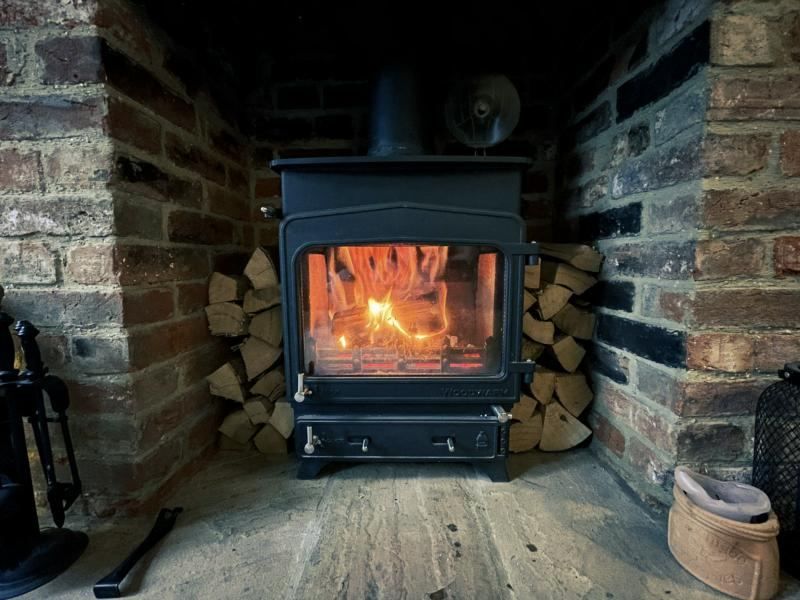
Wood is the classic inland heating fuel. Buying it in small bags is expensive: a 25 kg sack of holm oak at Leroy Merlin costs €23.29. Buying by the tonne from a local supplier is much cheaper per kilo. Ask neighbours who they use, buy in spring or summer when it’s cheaper and drier, and store it under cover. My heating guide covers stoves and how much wood a winter takes.
Internet and phones
Internet is a fixed monthly cost you’ll probably keep.
- Starlink: in mid-2026, new customers paid €35 a month for the entry plan plus a €10 monthly kit fee. Prices change often, so check.
- 4G or 5G router: unlimited data plans start at around €10 a month, if there’s good coverage.
- Phones: add your mobile plans.
See staying connected off-grid for the options.
Getting around
Off-grid usually means car-dependent. Budget for fuel, insurance, the annual or biennial vehicle inspection (ITV), and more wear on tyres and suspension than you’re used to. Our small EV charges from the panels when the sun allows, which helps; here’s how that works.
Track maintenance is the cost nobody warns you about. A storm can wash out a section of track in an afternoon, and you may share the bill with the neighbours. See nobody mentioned the driveway.
Insurance
Get home insurance, and be upfront with the insurer that the house is off-grid, with solar, batteries and its own water and septic. Make sure the policy covers the solar equipment and batteries, and storm and lightning damage. Ask about liability, too, if you have land, animals or visitors.
Land and fire prevention
Land needs looking after. Clearing dry vegetation around the house before summer is a safety essential, and in forest areas there are rules about fire breaks and burning. In the Valencian Community, the zone of forest influence extends 500 metres from forest land, and there are restrictions on burning in it. Budget for a brush cutter, fuel, and possibly help clearing larger plots.
The first-year surprises
Every new off-gridder I know had some. Ours included:
- A pressure pump that died in the first summer.
- More filter cartridges than I’d ever imagined.
- A ladder long enough to reach the panels for cleaning.
- A surge protector, bought after the first big storm rather than before it.
- Tools. So many tools. I wrote about that in electric tools and workshop living.
I’d set aside a contingency for the first year. Something always breaks or turns out to be missing.
One-off costs in the first year
Some costs only come once, but they tend to land in the first year, after you’ve spent most of your budget on the house. Plan for them:
- Paperwork you didn’t finish before moving in: legalising the solar installation, registering the borehole in your name, the septic permit, any regularisation of the house itself. See legalising a rustic house.
- Water treatment: filters, a UV unit, a water analysis.
- Tanks and pumps you didn’t know you needed until you lived there.
- Fire safety: extinguishers, a hose that reaches the house, clearing around the buildings before the first summer.
- Security: if the house is empty for periods, locks, lights and perhaps a camera on the router.
- The first winter: a stove if the house doesn’t have one, or a better one if it does, and a first load of wood.
How costs change in year two
Year one is the expensive one. By year two, most households have:
- Found their real electricity use, and either added batteries or changed habits.
- Settled on a water routine, and know how often they need deliveries or emptying.
- Bought most of the tools.
- Worked out where to buy wood, gas and filters cheaply.
That’s when running costs settle into a rhythm. Keep a simple spreadsheet in the first year, with every bill, and you’ll know exactly what to budget for the second.
A sample first-year running budget
Here’s an example for a family of four in inland Alicante, with gas for cooking and wood for heat. The prices are the sourced ones above; the quantities are my assumptions, so swap in your own.
| Item | Assumption | Annual cost |
|---|---|---|
| Water deliveries | 150 L a day, about 6 loads at €190 | About €1,140 |
| Internet | Starlink entry plan, new customer (€35 + €10 a month) | About €540 |
| Butane | 1 bottle a month at €18.84 | About €226 |
| Firewood | Depends on house and winter; buy by the tonne locally | Ask local suppliers |
| Septic emptying | Once a year at €174–€275 | About €174–€275 |
| IBI and local charges | From your seller’s receipts | Varies by town |
| Battery expansion fund | One extra module | About €900–€1,100 |
| Contingency | Breakages and missing bits | Your call |
With a working borehole instead of deliveries, the water line falls to the cost of filters, analysis and pump maintenance. With a 4G router instead of Starlink, internet could fall to around €120 a year. With an all-electric house and no wood, the gas and wood lines shrink, but the solar and battery system has to be much bigger, and that cost comes up front.
Habits that keep costs down
The cheapest savings in an off-grid house are habits, not kit. These are the ones that have made the most difference to our bills:
- Run the big loads in the sun. Washing, water pumping and car charging between late morning and mid-afternoon, so the batteries don’t have to.
- Measure everything once. A plug-in energy meter and a water meter after the pump showed us where the waste was. The old fridge in the workshop went the same week.
- Buy fuel out of season. Wood in spring or summer, when it’s cheaper and has time to dry. Gas bottles before the cold snap, not during it.
- Keep a spare of anything critical. A spare pressure switch, filter cartridges, fuses. The cost of a spare is nothing next to an emergency call-out or a weekend without water.
- Learn to do the simple jobs. Changing filters, cleaning panels, bleeding a pump. Every call-out avoided is money saved.
- Share with the neighbours. A trailer, a log splitter, a delivery split between two houses. In the campo, this is how things work.
Questions people ask me
Is off-grid living cheaper than being on the grid?
Day to day, usually yes, because you’re not paying for electricity. Over the life of the house, it depends on what the system cost and how long it lasts. The bigger saving is often that rural land without a grid connection is cheaper to buy.
What’s the biggest running cost?
For us, at first, it was water deliveries. Once the borehole was in, it became internet and heating fuel.
What did you forget to budget for?
The track, tools and filters. And the second pump.
Should I budget differently for the first year?
Yes. The first year is when you find out what’s missing. Keep a bigger contingency than you think you’ll need.
The bottom line
Off-grid living doesn’t mean no bills. It means different bills: water, gas, wood, internet and maintenance instead of a monthly electricity statement. Most of them are modest, a few are lumpy, and the first year always holds a surprise or two. Budget honestly, keep a contingency, and enjoy the evenings when the batteries are full and the stars are out. They’re worth it.

Leave a Reply